 On Left- charter school groundbreaking
Part 1 -Introduction
Should the attainment of assessed ability or achievement to performance capability be the standard for determining a disability?
Both the Individuals with Disabilities Education Act and Section 504 of the Vocational Rehabilitation Act specify legal definitions and outline requirements that entitle a child to receive specific services under the law. They are, however, based on projected potential with no regards to a child’s character. Where does that leave the overachiever who struggles to maintain average grades? Does not the denial of accommodations for this child disable him?
Bernard West is the principal of the South Dallas campus of a non-profit charter school organization whose mission is to “encourage individual achievement through the hands-on methodology of vocational education with rigorous academics excellence”. The organization has been in operation for 2 years on two campuses educating K – 6th grade students. They are leasing former parochial school facilities. The opening of Mr. West’s campus was delayed this year because of code required campus alterations. Bernie West meticulously managed the construction effort himself to ensure that all regulations were met. He is a by-the–book principal who prides himself on professional excellence.
Mr. McGill is a former Army Reservist and a single father raising his 11-year-old son. While he can walk for short distances with the aid of leg supports, he often utilizes a wheel chair. This is the start of his family’s second year at the public charter school. His son, Devon McGill had great difficulties adapting to the curriculum last year, but his homeroom teacher Ms. Thompson (and to a lesser extent, his mathematics and science teachers) made accommodations as their normal course of study. Devon was maintained as an average student with C’s in most subjects. Devon loved school and Mr. McGill was the 5th grade Homeroom “mom”.
Part 2 -The Principal's Point of View
M E M O R A N D U M
To: Samuel Tate, PhD., Founder and CEO, You Can Academy Inc.
From: Principal Bernie West, You Can Academy, Abundant Life campus
Re: Devon McGill, 6th grade
Action: Dr. Tate, I want to fill you in about the situation with Sam McGill and his son. Maybe we will have time to touch base on this matter before the Open House on Thursday night.
Fundamentally, the case of Devon McGill is another success story for our academy. Our regular academic environment supports this child to fully achieve commensurate with his assessment. We provided an expedient diagnostic process, utilized accomplished technicians in accessing his needs and did so with an economy of resources that recognize the needs of all of our students. True to our School Mission statement, we have encouraged individual achievement and have ensured that there is no barrier preventing him from attaining his station in life. Young Devon is a happy studious child who is not disabled.
Firstly, we strictly adhered to the timetable for assessment, as required [1]. At the end of last school year, Ms. Thompson mentioned to Mr. McGill the need to have a thorough evaluation performed on Devon. From initial referral to completion of full individual examination was within 60 days and the initial IEP/ARD meeting was scheduled within 30 calendar days (and before the first day of school). In oral expression, listening comprehension and arithmetic computation Devon’s overall level of Intelligence Functioning appears to be within the Low Average range. His verbal IQ is within the High average or bright range; His Performance IQ is within the Average range and his Full Scale IQ is at the low Average range. Devon’s individual profile contains skills ranging from the bright range down to the intellectually deficient range with his weakest skills involving concentration and visual-motor integration skills. However, he does not qualify as learning disabled because there is not a significant discrepancy between his Full Scale IQ and his standard scores achieved in those areas.
But, these findings were not unexpected. Ms. Thompson initially noticed a problem in Devon. You know that all of our teachers are certified or on a track to certification. They are “appropriately and adequately prepared and trained[2]”. Our contracted diagnostician is quite accomplished and her work illustrates that Devon is not prevented from achieving to his IQ. She emphatically remarked that “This child is not disabled!”
That is why it is so important that we extend our limited resources to the student most in need, as required by law. We must recognize and support students with actual disabilities as they are discovered on our campus. My grand efforts to accommodate those disabled individuals despite our limited budget, is well documented. As you know, the opening of our school this year was delayed because of requirements to bring the facility up to accessibility codes. A large exterior ramp was constructed leading from the sidewalk to the front portico and the inside lobby was subdivided to provide inclined access to the mezzanine office level. Toilet fixtures were removed from each restroom to accommodate handicap turn-around radiuses.
So you see that we have ensured that there is no barrier preventing Devon, or any other student here from attaining his station in life (in fact, the hard work that he shows in his class work efforts will be needed thoroughout his life) . Texas charter schools are not required to target learning disabled school children or even reflect diversity in the school community. Therefore, we will continue to maintain our niche and still strive to be all things to all people, pursuant to our mission of encouraging individual achievement. Should Devon be presented with barriers that impede fulfillment to his aptitude, we will surely deal with those. I understand that Mr. McGill may be contacting you, please help me to show him how our program has benefited his son.
Thanks, Bernie West
Part 3 - Parent's Point of View
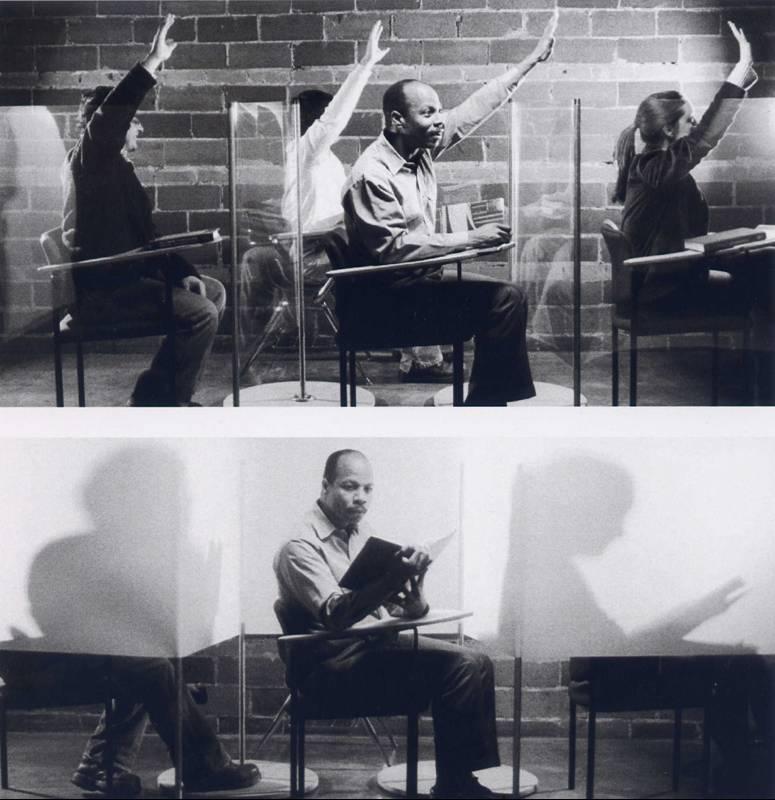
[At the Parent Open House- Abundant Life campus, on Thursday night in the gymateria. Dr. Samuel Tate, Founder and CEO of You Can Academy Inc. is concluding his comments to the parents assembled. Mr. McGill raises his hand ]
Mr. McGill: “I know you said that you would entertain ‘general questions’ but you know, my son is not one of your ‘success stories’ and we are now looking elsewhere for his schooling” [The audience strains back to see Mr. McGill.]
“You are the founder of You Can Academy and you have refused to recognize my son’s disability. Character cannot be ignored when determining potential, nor can you discount a parent’s unique perspective as to what is best for his son, nor can you pit one child’s need for resources against another. Moreover, pursuant to your vision of ‘encouraging individual achievement’, my son is entitled to support services”.
“My Child is not allowed special support because the fact that he earns C’s belies his very low performance expectations and thus he is not disabled and entitled to accommodations for his learning differences. When I was told that he was an overachiever, I was immediately proud because I am one as well. It was later that I understood the unfortunate paradox. My mantra to his educators has always been ‘My son should not lose his love for school!’, however, even with special treatment, my son was studying more than three hours daily- seven days a week. This spirit that propels individuals beyond their boundaries cannot be discounted. It must be recognized as an expression of purpose and a drive that is not inconsequential to the wellbeing of societies. My son must continue to receive supportive services as a matter of policy, not at teacher discretion”. [Mr. McGill wheels into the aisle way.]
“That is why as a parent I have a valuable and highly personal opinion that should usurp the professional expert. We parents must unite! I absolutely know my son and his potential best. It is obvious and well-proven that there is great wisdom in common masses. If one would quantify the knowledge that each parent innately knows about their children (the learning habits, the ways to enhance study, the quantity of homework they can handle) then those insights are more accurate than a trained professional observing my child[3]”.
“The concept that to provide services for my son would prevent a required service for another is not a burden to put on me or any other parent. It is a policy matter as to the priority and stewardship of the funds. Code required tenant improvements have no direct connection to providing tutoring or lessened homework or test accommodations for my son. Services must be apportioned to provide each student with the support needed to achieve”.
“And finally, to achieve what? To fulfill your mission statement, individual achievement must be to the child’s personal best. My son is now prohibited from the opportunity to excel in school and love school as much as I did. After leaving the IEP/ARD meeting it was hard to fight back the tears- partially to mourn the death of my son, the scholar; partially to dispel the dreams of reliving my scholastic life vicariously; partly in guilt for nightly threatening matches over homework; but mainly because my child’s opportunities in life were officially reduced. My son must receive an education that enables him to perform to the extent of his capabilities. I will not fail in this. Must he continue here, unsupported? Must we wait until he fails or looses his love for school? Devon must reach his full potential - not your projected potential.”
“Therefore is your treatment of us an indication of your success?” “Huh?” [Superintendent Tate stood ashen. Nancy Taylor’s mom emphatically inserted how well she enjoyed the Parent Pot Luck Mixer. She stammered something nonsensical that was met with accolades. So Mr. McGill rolled through the doorway, careened down the incline in the Mezzanine lobby and out onto the sidewalk.]
--Mikael Powell
Sources Cited:
[1] A Guide to the Admission, Review and Dismissal Process, Texas Education Agency, June 2002.
[2] 20 U.S. Chapter 33, Section 1412(15)(A
[3] The Wisdom of Crowds, James Surowiecki, page11, 2004.
{NOTE: The characters in the preceeding account are fictitious. This passage is to illustrate that in solving dilemmas in school reform, values are replete. Until you recognize them you will go around in circles. (COPYRIGHT © 2005 MIKAEL POWELL. All Rights Reserved)}