Wednesday, December 28, 2005

Research on the Properties of SHAPE MEMORY WIRES


EXPLORATION OF VARIABLES IN SHAPE TRANSFORMATION
by Dido Tsigaridi & Mikael Powell December 15, 2005
[excerpted from slide and video presentation]

Part I - Introduction to Material

A. Type 2 – Energy Changing Material
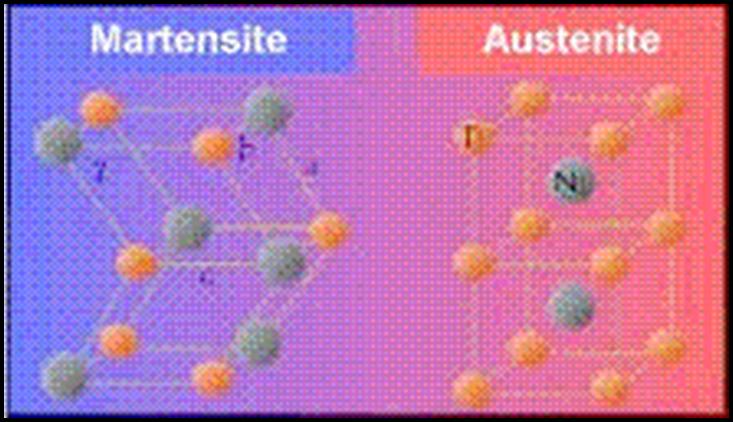
Direct Linear Change is caused by a temperature difference. This material has a uniform crystal structure that radically changes to a different structure at a distinct temperature.
B. Material States and Training - Shape Memory wires stressed at high temperatures react when subjected to heat.
Several elements in the Periodical Table of Element have been found to have shape memory effect qualities.
1. Originally SMA was discovered with Gold-Cadmium alloy but this was too expensive and toxic.
2. Copper-zinc alloy is used for extreme cold conditions.
3. Nickel-titanium is safer, less expensive, has high compatibility with living tissue and better deformation recovery ratio.
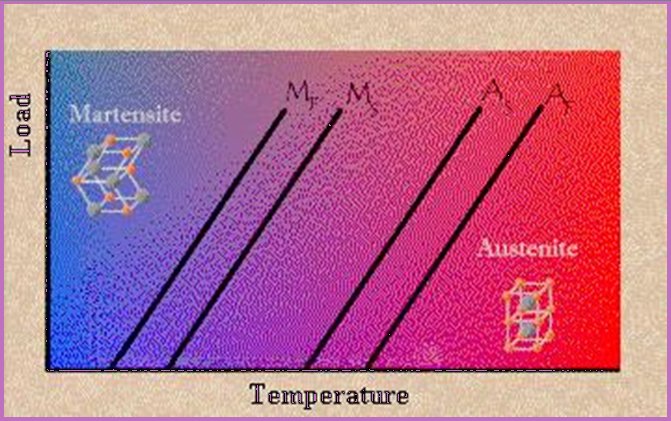
4. Properties: NiTi is temperature-activated. When cooled it becomes pliable, to be formed as you wish. Upon returning to its warm, resilient state, it "remembers" its programmed shape and returns to it - applying force against anything it its way. Nickel titanium is very resilient. It is lightweight, non-corrosive, biocompatible, wear resistant and more. Engineers specify nickel titanium for two qualities: shape memory and super-elasticity. Super-elasticity describes the material's ability to recover from large amounts of strain. A NiTi component can fully recover from strain values up to 8%. (Stainless steel, by comparison, will withstand only 2% strain.) The super-elasticity of NiTi allows it to perform functions that would permanently deform other alloys. If you design a NiTi spring, for instance, to have a transition temperature of 100 degrees, it behaves like a regular spring at temperatures above 100 degrees. (Here it's said to be in an austenitic phase.) Below 100 degrees, it's weak and pliable like a piece of solder. (This is its martensitic phase). Heating the spring above its temperature transition range causes the material to recover its former spring shape with considerable force.
The temperature at which this phase transformation occurs can be adjusted over a wide range.
C. Variables
1. Time – (effects include speed and fatigue)
[pix w/ graph]
2. Heat- (effects include trajectory)

Part II –Experimentation of Phenomenon Variables

A. Research on the effect of XXXX (above)
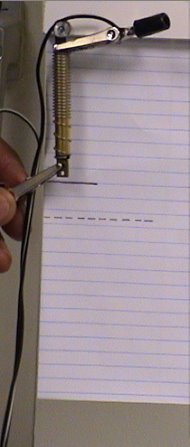
1. Introduction- Electric Pistons are an all-electric linear actuator shape memory wire mechanism that shortens in length with great strength and speed. Manufactured by Mondo-tronics Inc. it is calibrated to work with a 6 volt power pack with a maximum amperage of 5.0 and minimum amperage 2.0. Experimentation is to review how XXXX effect XXXX.
2. Procedure – One end of the piston is fixed to the wall. It is deformed to a specific length. Application is inducesd. Time is calculated.
3. Conclusion - Electric Pistons
Mode1 Mode2 Mode3 Mode4 Mode5 Mode6 Mode7
x:xxsec x:xx sec x:xxsec x:xxsec x:xxsec x:xxsec x:xxsec
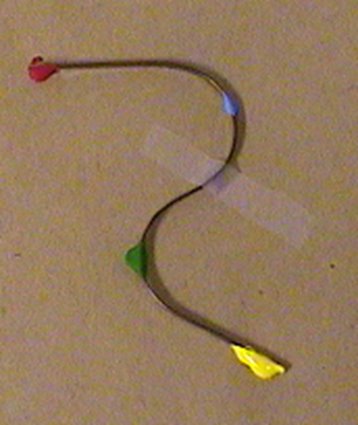


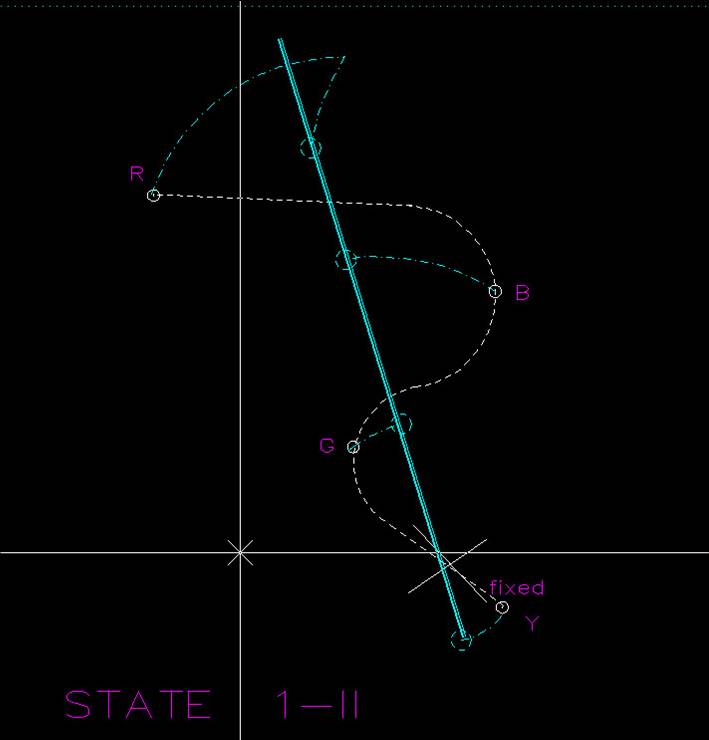
B. Research on the effects of X2 –Material Mode Photograph (above)

1. Introduction - Material is manipulated to explore transformation.
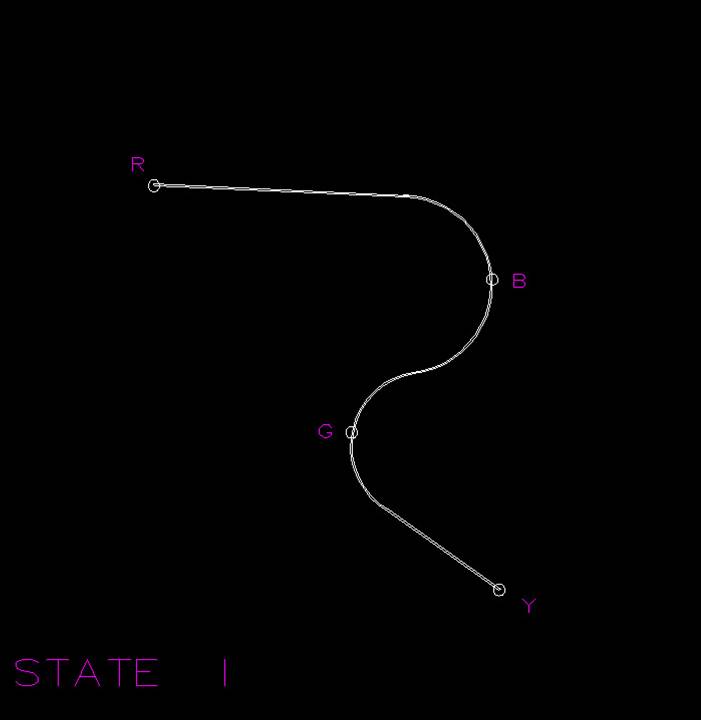


2. Application – XXXX–Charted Mode I, II, IIabc (above)
3. Conclusion - Variables can be systematically interacted exhibiting proportional responses.

C. Research on Re-Set Capabilities
1. Introduction: Many SMA components need to be reset to state I by mechanical means. We are researching whether a reset phenomenon can be developed to allow for a self-perpetuating cycle.
2. Procedure: Two Electric Pistons (an all-electric linear actuator shape memory wire mechanism) were used. The devices were connected together and systematically activated.
3. Conclusion: Reactions can be effectively induced to provide reset capability.
(COPYRIGHT © 2006 TSIGARIDI/POWELL. All Rights Reserved)

-END-

[I-4] When Walking and Talking Become the Duck


Initiating Ethics for Ghost-mapping in Architecture, Education and Performance
by Mikael Powell


“When I see a bird that walks like a duck and swims like a duck and quacks like a duck, I call that bird a duck.”

James Whitcomb Riley’s famous quote at the onset of the 20th century could not, through its simple elegance, presage the future complex relationship between technology and human perception. Even futurists in the mid 1940’s envisioned remote robotic operations when coining the phrases ‘cyberspace’ and ‘telepresence’ with the vehicle of interaction being a proxy of one’s presence (abdicating the projection of one’s actual spirit to a surrogate). In the 1980’s methods such as video conferencing attempted to synchronize audio and visual perception in an effort to simulate direct interaction, but always the participants were cognizant that the users were not truly, personally, present in the exchange. Indeed, that technology was based on connecting two distant presences.

The turn of the latter century brought many sophisticated research developments in the quest for creating the phenomenon of being simultaneously present in remote locations. PingPongPlus is a reactive ping-pong table for participants in two different locations with each sportsman playing against the phantom responses of the other. The Lumitouch system consists of a pair of interactive picture frames. When one user touches the picture frame in their home, the other picture frame lights up in a remote location as if locally activated by a loved one’s ghostly presence. Under development are environmental accessories which produce a two dimensional real-time medium for shared interaction between individuals. Thus, when individuals can meet in real-time with an image of another (either 2D or 3D in real space), with the sound of another and movement of another, interacting with another, can this experience be deemed illegitimate?

I have coined this area of research as ‘Ghost-mapping™' when the element of reactionary movement provides a transaction that is so powerful in establishing presence that even a slight indication of self is adequate to produce the effect. In education, it can provide for a learning environment where all students receive a modulized unique lesson plan at the classroom desk. It can provide another venue of direct interaction for the acting community and transform architectural spaces by incorporation of this new portal. It can extend the physicality of one human to places unbound by time and distance. It can relay intimate loving caresses but also be an agent of remote governmental torture. This essay reviews the emergence of Ghost-mapping and offers reflections on ethical guidelines for the use of this created phenomenon.
(COPYRIGHT © 2005 MIKAEL POWELL. All Rights Reserved)

Monday, October 31, 2005

[I-1] [I-2] "Ω” - (the reform formerly known as)

First, let me say that I found the article ‘the Politics of Curriculum and Testing, Chapter 13 - Systematic School Reform (Smith and O’Day 1991)” very intriguing and I am in the process of dissecting it and reviewing the sources. The impetus for this reform is a state initiative “to provide a coherent direction for education reform” which is derived from ”a common vision”. They remark that underlying any coherent vision is an important set of values and they proceed to discuss the power of values held in common. I, of course, look at these values as an impediment to education reform. While I think that the intelligent person recognizes the values laden in Education, as in “Let’s reform Education!”, I think many stakeholders in the state policy arena, particularly the electorate and the politicians, do not. Therefore, as Cuban offers “are we destined to go around in circles?”

Perhaps the first step to school reform is to popularize one national concept of education—and then, with everyone on the same page, we can seek to reform that element. I am partial to individuality in education and the ‘personal best’ model.
Alternatively, if we cannot convince everyone of that goal for education, then perhaps we can appropriate an old-fashioned term for learning like “acroamatics[1]. We can then talk about Acroatic[2] Reform in very universally specific ways.

Or perhaps, the reform needs to be a symbol like “the artist formerly known as”. We can “Reform School Ω”. Maybe in this form we can de-value this concept of education. Then the reform can be about a specific notion, precise goals and dispassionate assessment.
Regardless, this exercise in vocabulary is not pedantic. Even Smith and O’Day base their reform strategy on a unified vision and goals. --Mikael Powell

Sources Cited:
1. Acroamatic - Webster's Revised Unabridged Dictionary, © 1996, 1998 MICRA, Inc. \Ac`ro*a*mat"ic\, Acroamatical \Ac`ro*a*mat"ic*al\, a. [Gr. ?, fr. ? to hear.] Communicated orally; oral; -- applied to the esoteric teachings of Aristotle, those intended for his genuine disciples, in distinction from his exoteric doctrines, which were adapted to outsiders or the public generally. Hence: Abstruse; profound.
2. Acroatic - Webster's Revised Unabridged Dictionary, © 1996, 1998 MICRA, Inc. \Ac`ro*at"ic\, a. [Gr. ?, fr. ? to hear.] Same as
Acroamatic.

Wednesday, October 26, 2005

[I-1][I-2]Classroom Design for Scripted Curriculum


On Left-Second grade teacher Garnet Mell teaches her classes based on scripted lessons plans from Success for All.

First of all the dilemma of many new teachers in the K - 8 environment and exemplified in the article “Lost at Sea” by Kauffamn, Johnson, Kardos, Liu and Peske really hit home to me. While I have never taught elementary school, I was an adjunct professor in an university school of Architecture. There was no curriculum guide (other than a sentence about my course from the every-six-years accreditation board) and no supervision. Moreover, the department head considered me successful if they never heard anything about me – No gripes from me, my students or their parents. Well, the flipside to no curriculum is a main focus concern–the scripted curriculum.

This issues brings me back to Landson-Billing’s article “But That’s Just Good Teaching”, where they categorize the successful teacher as one who was “not dependant on state curriculum frameworks or textbooks to decide what and how to teach”. Yet I learned that variance from the framework of the reform can make the true effectiveness of the reform curriculum not assessable. In my readings this week I noted that Cohen writes about the “gap between the curriculum developer’s intentions for students and what actually happens in lessons”. So, I suppose that effective reform must begin with a well devised curriculum that is completely implemented and correctly assessed. Therefore, I wonder if the Model Classroom of the Future can’t function in two formats –

1.) A Teaching Classroom (funded by the national textbook companies). In this learning environment the printed curriculum would be replaced by the mass-customized learning media arriving directly to each child and uniquely crafted to sort each student’s presentations based on his last response. Teacher support and all student actions would be quantified and recorded for use in revising the curricula.

2.) A Learning Classroom in which the learning media arrives directly to each child, modified by a student’s actual responses. The efficacy of the lesson for each child can be directly derived from individual assessment. The learning media should certainly incorporate the 5 domains discussed in “Reform: By the Book…” by Ball and Cohen and the learning media would not be a single purchase, but an on-line, real-time system that is constantly revised. Perhaps it is modified in a fashion to emulate the current Japanese model of incremental review. --Mikael Powell

++++++++++++++COMMENT---Hi Mikael: I'm still intrigued by your content-delivery idea - I've never even considered it, and it seems brilliant from a first-take... standardize delivery of instructional content we can all agree on, at some national level using technical skill (the technician side) at relatively low cost, then specialize/differentiate other value-laden content using professional teachers hired at a local level... a sort of 'split day' that could generate some basic levels of competenceat a national scale, while allowing for local control and delivery of everything else... go after this!! And then tell me when you figure it out!! :)C