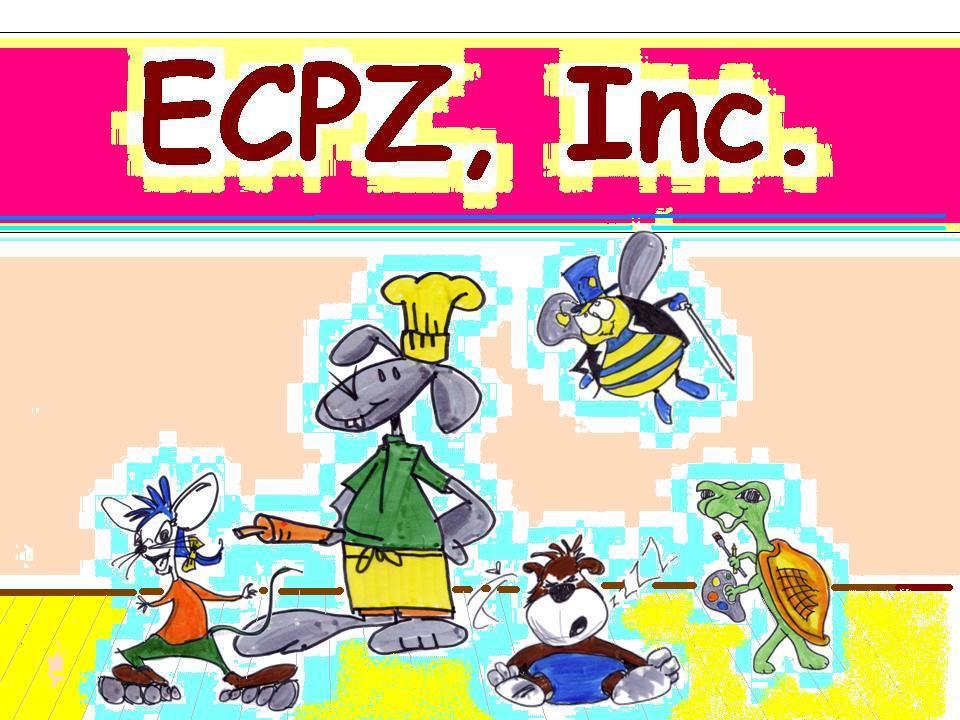
 Left to right: Zip, Pepper, Cozy, Watson and Emo
(images originated by John Tran and Jerome Daescowicz based on researcher's concepts).
ECPZ INC: A HOLISTIC APPROACH TO A HEALTHY LIFESTYLE
By Powell, Gibas, Jhalani, King, Rauch
Abstract
A feisty turtle named Emo bursts out of his shell to make a painting. Meanwhile, his rabbit friend Pepper busily prepares a healthy feast of colorful, nutritious foods. In the corner, a drowsy bear settles down for a nap, while an energetic mouse zooms onto the scene on roller-skates, itching to play tag, baseball, or anything to get her heart pumping, and an elderly bee supervises the scene fondly reminiscing about his days as a mind-reader in the circus. Individually, each of these characters represents a vital component of health. Together, they comprise the cast of ECPZ.Inc, the main element of our proposed media campaign to address the childhood obesity crisis.
The goal for this initiative is to help 4-6 year old children and their caregivers understand that a healthy lifestyle is a balanced lifestyle. Health in this context refers both to physical and emotional well-being. The campaign focuses on four components of health: eating nutritious food, being active, expressing oneself, and getting enough rest. It aims to assert the importance of each individual element while emphasizing that all the elements must work together in order to achieve and maintain a healthy life.
Children suffer from a variety of physical and/or emotional imbalances that can be corrected with the help of this campaign. Several studies indicate that shifts in diet and exercise alone cannot fully account for the health gap between rich and poor in the United States. Nor can one emphasize any “quick-fixes” without deference to a holistic approach toward health. Likewise, children must learn to find their own balance between caloric intake, physical activity, and proper rest. Such balance is important not only for bodily health, but to help children cope with the instances of stress and anxiety that enter their lives.
With these considerations in mind, we propose an animated television show that promotes an array of healthy habits, not in isolation but in relation to one another. In each episode, our “rescue” team comes to the aid of health-challenged citizens of their world with creative, entertaining solutions, Critically, while each character contributes a particular strength, solving the problem always requires that members of the team work together. Additionally, we will develop a corresponding toy product line to reinforce our message. We also envision collaborations with partners ranging from hospitals to fast food corporations. As a result of this campaign, children and caregivers will have an increased awareness of diverse components of healthy living and the importance of achieving a balanced combination of all of them.
Table of Contents
Section
I. Audience Needs
II. Proposed Intervention and Outline of Specific Objectives
III. Supporting Research
o Television as an effective medium for intervention
o Toy Line as an effective medium for extending learning
IV. Overview of Show
o Structure
o Distribution and Audience Reach
o Characters
o Plotlines
V. Overview of Toy Line
VI. Assessment Strategies
o Formative evaluation data
o Summative evaluation strategies for show and toy
VII. Outreach and Partnerships
VIII. Conclusion
VIV. Bibliography
X. Appendices
o “Too Much Hurrying in Hurryville”
o Formative evaluation transcripts
o Character images (at top of document)
o Toy images ( Not included)
I. Audience Needs
Research indicates that children suffer from a variety of physical and/or emotional imbalances that can be corrected with the help of our intervention. An example of a serious imbalance in U.S. children is childhood obesity. Childhood obesity is a condition with serious mental and physical health repercussions; apart from the negative psychological impact of obesity, studies show that obesity can lead to conditions such as diabetes, cardiovascular disease, and high blood pressure (Dalton, 2004). It is estimated that “one out of three children and adolescents ages six to nineteen is overweight or at risk of becoming overweight [in the US]” (Dalton, 2004).
An overview of the research suggests that four main imbalances contribute to health disorders such as obesity in children. These are poor diets, lack of sleep, low activity levels, and mental health issues.
1. Poor Diets
Statistics show that kids in the US, regardless of weight, are not eating healthy diets. One study showed that only 2% of school children were eating from the recommended servings of the then current USDA Food Guide Pyramid (USDA, 2000). The USDA Food Pyramid emphasizes fruits and vegetables as essential parts of a healthy diet. However, according to the 2003 Youth Risk Behavior Survey, only 22% of youth in grades 9-12 ate five or more servings of fruits and vegetables daily (CDC, FY 2003).
The omnipresence of fast-food chains often contributes to children’s unhealthy diets. The popularity of fast-food chains is reflected in a study that showed that on an average, children ages 11-18 eat at fast food restaurants twice a week (Paeratakul et al., 2003). Alarmingly, eating at fast food chains is unhealthier than ever, a fact partially due to the increased portion sizes. According to one study, from 1977-1996,
o Soft drinks increased from 144 to 193 calories
o French fries increased from 188 to 256 calories
o Hamburgers increased from 389 to 486 calories
(Nielsen et al., 1996)
Some of the statistics cited above focus primarily on the dietary habits of children that are older than our target audience. However, we believe that these studies are relevant to our intervention since many food habits are formed when children are young. By encouraging positive eating habits amongst younger children (4-6 year olds), ECPZ, Inc. can help these children make healthier food choices as they grow older.
2. Lack of Sleep
As a result of an increasingly high-pressured and busy lifestyle, many children are not sleeping as much as they should. A survey commissioned by Pampers and conducted with the nonprofit National Sleep Foundation exemplifies this point. This study finds that 26% of parents of children 0 – 4 years old said that their children do not sleep enough (National Sleep Foundation and Pampers Baby-Dry, 2005). This harmful sleep pattern also has negative consequences for the child’s parents; of the adults surveyed, 71% said they get less sleep than they feel they need.
3. Low Activity Levels
Research on the activity habits of today’s children further motivated us to devise an intervention that encourages an active lifestyle. According to their parents, children six years and under spend less than two hours a day playing outside (Rideout et al., 2003). This supports our intervention which encourages active lifestyle habits in children. The potential criticism regarding using television watching (an ostensibly passive activity) to promote an active lifestyle is discussed in a later section. The importance of our intervention increases in light of research indicating that the public school system is inadequately addressing the low activity levels of children. One study found that only 8% of elementary schools, 6.4% of middle schools, and 5.8% of high schools provide physical activity education [in the US] (CDC, 2000).
4. Mental Health Issues
The stress related to unhealthy physical habits takes a toll on a child’s psychological and physiological health. Anxiety disorders currently rank as one of the most common groups of mental and emotional afflictions in the United States. According to the Department of Health and Human Services (DHHS, 2006), approximately 13% of children and adolescents between the ages of 9 and 17 suffer from an anxiety disorder prior to reaching adulthood. Of those, 50% go on to experience a second mental disorder such as depression. Like obesity, stress and anxiety are also related to a variety of physical symptoms and illnesses, such as insomnia, digestive problems, high blood pressure, and heart disease (Epstein, 2003). Many anxiety disorders can be solved with early intervention. However, as Webster-Stratton (1997) notes, “mental health services often target older children and teenagers, [while] preschool intervention programs often target cognitive, language and motor delays, and may neglect primary social and emotional issues that trouble young children” (cited in Evangelista, 2004).
II. Proposed Intervention
The goal of this campaign is to promote a holistic approach to health – to help children between the ages of four and six and their caregivers understand the need of balance within the context of a healthy existence. Wellbeing entails both physical and emotional vitality. The components of our program stress healthy foods choices, physical activity, emotional expression, and ample sleep. Our campaign focuses on asserting and reinforcing both the importance of each individual element as well as the need to jointly balance them everyday.
The primary medium we will employ is a television program, and the message is extended through a corresponding toy product line. In addition, we envision collaborations with several public social agencies, private clinics and business corporations.
After viewing the program, children should be able to understand and articulate the need to balance oneself within the context of a daily regiment. Furthermore, they should be able to identify the four key components of balanced health: being active, eating healthy, expressing your emotions, and sleeping enough. Use of the toy line will reinforce the campaign’s messages of the relationship between the four healthy components, and will allow children a manipulative personal experience with each health area. Our young viewers will understand that different aspects within their life condition might be more useful in dealing with particular problems, and that there is no solution that is always effective without deliberation. Caregivers who watch the show and buy the toys should also be able to identify the four components of balanced living and specific actions associated with them. We feel that this awareness will be instrumental in their acquiring and maintaining a healthy lifestyle for themselves and their children.
III. Supporting Research
Television as an Effective Medium for Intervention
While it is not our only medium, television serves as the focal point of this holistic campaign. In effect, our other points of entry – whether toys or caregiver supplemental materials – gain their efficacy through being associated with an entertaining television show. This decision, however, presents us with an inescapable dilemma, for we are choosing to combat unhealthy lifestyles through a medium many researchers consider unhealthy in itself. However, in light of current media theory, health campaign literature, and general data on the ubiquity of televisions in the US, we felt the positives of using television far outweighed its potential harms. In addition, the previous use and efficacy of television in health media campaigns further reassured us in our vision and direction.
99% of American children live in a home with a television, while 36% of those children have a television in their own room (Rideout et al, 2003). This penetration allows us an access unparalleled by any other form of electronic communication – a point underscored by the fact that 4 – 6 year olds spend an average of 70 minutes watching television every day (Rideout, et al, 2003). In light of these numbers, the question of whether to use television to promote our message turns instead to how do we best get that message across to effectively promote a balanced lifestyle.
Researchers have written extensively on the effects of television on children (see Gentile et al, 2002), and whether those effects are positive or negative, the fact that television can change behavior is very encouraging from our perspective. Bandura (2001) writes of the capacity of television to directly influence behavior without any intermediary influence. Behavior can be learned after one exposure to a show and entails three processes – understanding a character’s traits, incorporating those traits into understandable rules, and then transferring those rules into new behavior (Bandura, 2001). Our show models these characteristics by providing characters our audience can relate to, rewarding their behavior, and making their thoughts and actions explicit. Thus, through these three processes, we can positively alter our audience’s awareness and behavior.
Our show also reflects the work of Davies et al (2004) who discuss children’s desires – humor, action, and character similarities – as television viewers. These desires are crucial, as an intervention is dependent on the obvious fact that children must be engaged. It is only with that engagement and investment in the characters and stories that Bandura’s processes can be both internalized and realized. Repetition facilitates this process (Palmer et al, 2001). Due to syndication and scheduling, television lends itself to repeated viewings. Future marketing and development of DVD’s and home videos – a market with extremely lucrative potential (see Rideout et al, 2003) – further allows for this repeated viewing and internalization of our key message.
Toy Line as an effective medium for extending learning
Including a line of educational toys in our intervention will further increase the appeal of our show, and of our message, for both children and caregivers. Educational toys are currently the fastest growing area of the U.S. toy market (Hardwicke, 2003). They are in high demand among parents, and with good reason. Toys that promote creative play have been shown to have a lasting impact on children’s cognitive development (Linkenhoker, von der Ohe, & Knudsen, 2005). They provide practice with a wide variety of skills, such as vocabulary and communication, empathy, understanding social roles, planning, and creativity (Singer, 1977 & 1994). By making the toys appealing both to children and to the caregivers who will buy them, we can ensure that children will have real-life opportunities to practice the range of healthy behaviors promoted in the show.
All of the ECPZ.Inc toys will not only reinforce the content of our balanced health message, but will have qualities proven to promote cognitive development. The main ECPZ.inc toy will be designed to remind children of the four key elements of health as they play, as well as of the necessity of achieving a balance among them. In addition, this toy will have the following important qualities of good educational toys: it will allow for open-ended play; encourage self-expression and creativity; have the potential to be used in a variety of different ways and to be tied in with other media; allow for multiple players to be involved, and have the ability to grow with the child (Andrews, 2006; Hardwicke, 2003). The main toy and many of the individual character products also fall into the five categories of playthings that have been shown to enhance learning: building toys, art supplies, imaginative play props, sports equipment, and puzzles (Adcock, 2006). Thus, we believe that supporting our TV show with a line of toys is a highly effective way to extend children’s learning beyond the show and to increase the likelihood that they will begin to incorporate some of the components of a healthy, balanced lifestyle into their own lives.
IV. Overview of ECPZ. Inc Television Show
Structure
EZPC. Inc is an animated television show approximately one-half hour in length. Following the structure of existing shows such as Pinky Dinky Doo, each episode will be comprised of two seven-minute storylines, with four-minute live-action “filler” segments in between. Each episode will be bound together by a curricular theme – for example, balancing rest and activity. The first story segment will involve one or more of the characters being sent on a rescue mission away from the team’s base. The second story segment, while dealing with the same theme, will focus on the characters resolving a conflict amongst themselves. In keeping with our holistic approach, we aim to model the particular lesson on several of the characters, not just the one who symbolizes the health component most associated with the “solution” to the problem. Thus, for example, an episode dealing with the relationship between activity and rest shows Zip and Cozy (the characters with whom activity and rest are associated) going on a rescue mission, but then shows the remaining two characters dealing with, and resolving, a similar problem. In this way we emphasize that balancing between rest and activity is important to all of the characters, not just those who particularly like to sleep or exercise. The live-action sequences, finally, will show children sharing their own stories, activities, and suggestions that pertain to the theme. These sequences would be hosted by Watson, the “group leader” and “teacher figure” of the show. He will also provide a curricular “wrap-up” at the end of each segment to reinforce the primary messages of the episode and provide tips for parents.
Distribution & Audience Reach
The length of EZPC.Inc can be modified to accommodate time for advertisements should the show be picked up by a commercial rather than public network. In order to attract as wide an audience as possible, we will post episode segments on the show’s website so that parents may access them at their leisure. The site would also allow parents and children to write in comments and suggestions for the live action-segments, or email pictures and videos of themselves participating in certain activities.
Characters
The cast of EZPC.inc was designed to be as appealing to children as possible. In addition to modeling a specific component of health, each character has a dynamic personality with specific likes, dislikes, and quirks. Visual images of these characters are available in the Appendix 3, and their key characteristics are outlined below.
Emo (Express Yourself)
Emo is a chatty, excitable, vaguely hyperactive turtle. He has a tendency to bust out of his shell and run around like mad when he’s excited, and carry around and/or crawl into his shell when he’s tired or depressed. The patterns and colors on his shell change depending on how he’s feeling (and when he’s not sure, the shell starts flashing all sorts of crazy colors and shapes), and provide a signal to the other characters that lets them know what sort of a mood he’s in. The shell also doubles as a “storage space” for a whole host of tools (paintbrushes, sketchbooks, paper, costumes, makeshift musical instruments) he takes out whenever talking about his feelings isn’t enough. Emo is very crafty, and will make musical instruments and theater sets and costumes out of normal household objects. He also keeps track of trusted adults and/or authority figures that can be approached in times of need. One of his particular skills, in addition to general artistic inclinations, is the ability to identify when outside help is in order, and who can be trusted.
He gets along very well with the other characters, though his tendency to “wear his heart on his sleeve” will sometimes get him into trouble. His chatty nature, for example, leads him to sometimes say things before he has completely thought through the consequences. Similarly, when he is feeling down and in a bad mood, he can talk about his feelings so much that the other characters start feeling down themselves. In those cases, Emo enlists the help of another character (notably Zip or Cozy) to come up with alternate ways of releasing negative feelings. When dealing with others’ conflicts he is an excellent mediator because of his high capacity for sensitivity and empathy, and often pulls the other characters into participating in group projects. The group’s headquarters is decorated with all sorts of things Emo has made.
Cozy (Get Enough Rest)
Cozy loves comfort, which is why, she is quick to explain, she is rarely seen not wearing her pajamas. They’re loose, they’re soft, and they’re perfect for lounging out and falling asleep – anytime, anywhere. Cozy isn’t lazy; she just doesn’t particularly like to over-exert himself. She’s perfectly content settling amongst a pile of pillows, drinking cocoa, and reading her favorite book. As a result of her emphasis on comfort, she and Pepper get along really well, and she’s eager to help Pepper cook a yummy meal – though despite her best intentions, she might nod off before the meal is ready. Cozy also works well with Zip, though their relationship is sometimes contentious. Cozy’s not a big fan of running around, but she’s good at noticing when other people are working too hard. As a result, she tends to be good at dividing up work to ensure that everyone contributes fairly. She’s a pretty sensitive bear, and takes good notice of the “simple things in life” like the warmth of the sun or the comfort of a worn coach. Her actions are always well-intentioned, even if she gets distracted by sleep and takes longer to finish tasks than her friends.
One of Cozy’s strengths is her ability to make any area “homey” – she can always manage to dig up some blankets and pillows when they’re needed. She also loves talking about the dreams she has, no matter how bizarre. Emo occasionally helps her make a drawing or write a poem about the adventures she dreamed the night before.
Pepper (Eat healthy)
Pepper is Mozart meets Rachel Ray – in rabbit form. Of the four, he is by far the most studious character. He is adventurous but tends to be a little more withdrawn than the rest of the team, and thinks things through before speaking or acting. He has a “crazy genius” air to him when cooking or eating. Taking a taste of any dish reminds him of where he was when he first learned the recipe, and he loves ruminating on the textures and colors of different foods. He also loves to experiment, to the point that some of his concoctions are fairly bizarre, but always healthy. He carries supplies around in his chef’s hat, which he’ll tie down this his ears if it becomes too crowded and heavy. Pepper also carries a little notebook in which he keeps track of all the meals he’s made that week, so he can be sure he’s gotten a good mix of colors and food groups.
Pepper’s failing is that sometimes he is so studious that he forgets to have fun, at which point Zip and Emo step in to get him involved in a game. He is meant to serve as a model for the more shy, withdrawn children in our audience.
Zip (Be Active)
Zip is one crazy mouse – she talks and moves a mile a minute. She zooms around and roller-skates and carries a backpack with balls, bats, tennis rackets, jump ropes, chalk, Frisbees, running shoes – anything that lets her jump around. Zip appears to have boundless energy and enthusiasm, which can sometimes get her into trouble, as she has a tendency to “bite off more than she can chew” with tasks and projects. Sometimes she is in such a hurry she forgets to eat well. Zip likes to “think big,” but sometimes needs her friends’ help to figure out how to make her ideas a reality. She also loves nature and talks about how much she enjoys the feeling of “getting her heart moving.” Her affection for “simple things” like sunshine and fresh air is shared by Cozy, and this commonality often helps them through the more turbulent moments in their relationship. Zip’s enthusiasm, however, sometimes leads her to be a bit rash, and on occasion Watson has to step in and gently remind Zip of the importance of safety, particularly when she scampers up trees or cajoles the group into a friendly game of tag.
Some of Zip’s less favorable characteristics are her impatience and hatred of being bored. Luckily, if she’s stuck inside on a rainy day, she and Emo will work together to think of some kind of creative game to keep their minds and bodies occupied.
Watson (Be Aware; holistic health model)
Watson is a fumbling, bumbling, grandparent-like bee. In younger days, Watson was in the circus, starting as a juggler, then a tight rope walker, a “mind reader” and finally a Ringleader. As a result, he is quite aware of the importance of balance and observation. He often reminisces about those days – sometimes rambling on and on and boring the team -- and represents an older, more “mature” perspective on the conflicts at hand.
Watson sets the group’s missions, but also adds some of the scaffolding in the show by going over the steps and repeating the main points in a (sometimes bumbling) effort to keep the, straight. Watson often uses mindful steps to clearly determine, for instance, whether a character is truly hungry (i.e. look at the interval since his/her last meal, determine what signals his/her body is sending, and so forth) The characters love and respect him, and go to him when they need help resolving disputes among themselves. In those instances he will usually guide them to the right conclusion by asking them to think about or observe (be aware of) the situation around them.
Plotlines
Below are three sample storylines that illustrate the overall themes and structure of EZPC. Inc. While each episode typically focuses on balancing between only two of the four components of health, we will model all of them consistently, in keeping with our holistic approach. A “storybook” version of segment 1 of the first episode is available in the Appendix.
Episode Theme: Balancing Between Rest and Activity
Segment 1: Zip & Cozy
Zip and Cozy are sent to Hurryville to help the mayor write his speech. At first, it seems that the mayor only needs some rest to get his work done – but when he oversleeps and nearly runs out of time, the characters emphasize the importance of balancing rest with a good amount of activity.
Segment 2: Pepper & Emo
Pepper has discovered a new recipe that he’s really excited about – but it’s very complicated, and as he cooks, Pepper realizes dashing between four pots takes a great deal of energy. He’s convinced he can take care of it himself, until Watson reminds him that his hurried manner is making him unsafe, and tells him to take a break and let Emo stir for a while. The two divide up the work and are relaxed and happy by the time the others return.
Episode Theme: Proper Nutritional Balance
Segment 1: Pepper & Zip
Pepper and Zip respond to a family whose daughter swims in a race every year – but this year her stomach hurts and she says she no longer wants to swim. Zip tries to get her excited about swimming again, but the real problem turns out to be Choco-Blast bars, the hot new candy in town. Choco-Blasts are new, cheap, and everywhere; all the kids are eating them. Pepper gives the family a lesson on how Choco-Blasts should be used as a “sometimes” food, or be mixed into a healthier dessert like fruit, and the girl’s stomachache disappears in time for the race.
Segment 2: Cozy & Emo
Emo’s feeling sad, and to make him feel better Cozy resorts to her “comfort foods,” including cocoa and giant cookies. The more Emo eats, the yuckier he feels, and Cozy solves the problem by getting Emo outside to enjoy the fresh air and relax in the sun. By the end, of course, Cozy is so relaxed she falls asleep and Emo practically has to carry her home.
Episode Theme: Getting Over Fears
Segment 1: Cozy and Emo
Cozy is sent to help a boy who doesn’t want to sleep. The boy claims he’s wants to finish the end of his favorite book and doesn’t need more rest, but after talking to him Cozy realizes that the boy had a nightmare and now is afraid of the dark. She sends for Emo and together the two of them show the boy how to take what he’s “afraid” of and make it funny. They wind up making a crazy art project and having a great time.
Segment 2: Zip & Pepper
Zip has come up with a new baseball game she can’t wait to try. When she tries to get Pepper to play, he refuses, and Zip gets angry. It turns out that Pepper doesn’t want to play because he’s afraid of getting hit with the ball. Once he expresses his fear, Zip modifies the game (with the help of Watson, who steps in with a message about safety) and Pepper gets over his fear.
V. Overview of Toy Line
The second major component of our intervention is a toy and product line. The anchor of the toy line will be a toy that incorporates all four key elements of health and reinforces the concept that these elements must be balanced. In order to reflect the four elements of health, this toy will have a cross-shaped base with four branches, each branch with pictures and/or symbols representing one of the TV show’s characters. Connecting blocks, like Legos or Pop-Onz (Appendix 4a), will be designed to be stacked on top of the base. Ideally, these building blocks would be designed so that those that fit on one branch of the base will not fit on any other branch (for example, all of Pepper’s blocks could have triangular connectors while all of Zip’s blocks could have square connectors). In addition to the basic building blocks, the toy will include special pieces that have pictures or moving parts that represent each character. For example, one might be able to attach a swinging hammock to Cozy’s branch, or Pepper’s special pieces could have pictures of different kinds of healthy foods on them. The toy will also include figures of each character, so that children can build structures and then engage in imaginative play using the show’s characters.
In order to reinforce the concept of balance, the base will be designed so that it can be balanced on a fulcrum, similar to the “Topple” game depicted in Appendix 4b. If the child builds on each branch of the toy equally, the base will balance neatly on the fulcrum. If the child has weighted down any branch of the base more than the others, the base will be off balance and tilt to one side. This design will subtly underline the message that the four elements of health must work together, and that one should not emphasize one area over the others. We could further reinforce this message by providing the option of turning the toy into a multi-player game in which the goal is to be the first to balance the board—for example, by drawing cards that instruct the players where to add blocks to the base. However, for younger children or for individual creative play, the base can still be removed from the fulcrum and played with on a flat surface.
In addition to this anchor toy, we propose to design individual product lines for each character. For example, Emo could have a line of arts and crafts materials, while Zip might have a line of sports equipment (see Table 1 for a more detailed list of potential product lines). As described earlier, the objective of these product lines is to provide children with opportunities to gain hands-on experience with each of our key areas of balanced health. In the packaging of each of these toys, we can also include a card or brochure with tips and information for caregivers from Watson having to do with that particular area of health. In addition, we propose to include in the packaging a special piece to go with that character’s branch of the anchor toy. This would encourage children and parents to buy from different characters’ product lines, so that they can collect special pieces to go on each branch of the main toy. Together, the anchoring balance toy and the individual product lines will play a key role in extending the message of our show that one must balance eating healthy, being active, sleeping enough, and expressing one’s emotions in order to lead a healthy lifestyle.
List 1: Individual Product Lines
PEPPER - Message “Eat Healthy”- Products: Play food sets, “Grocery store” toy, Food puzzles, Licensed snack foods, Book of recipes, Coloring books, farm, supermarket, etc.
ZIP- Message “Be Active”- Products: Sports equipment like jump rope, balls, horseshoe game,
pogo stick, etc., Activewear clothing line, Indoor/outdoor activities book.
COZY- Message “Sleep Enough” - Products: Sleepwear, Stuffed animals (teddy, etc.), bedding
Bedtime stories, Nightlight, Alarm clock.
EMO- Message “Express Yourself” - Products: Arts and craft materials: crayons, markers, paints, paper, clay, etc., Puppets/Puppet theater, Musical instruments, Feelings book, Feelings chart (“Today I feel…”) with stickers.
VI. Assessment Strategies
Formative Evaluation Results
Our formative evaluation allowed us to test our character and story ideas, while providing us with the opportunity to incorporate that feedback into our final proposal. We were interested in exploring two primary questions. First, are children able to comprehend our general theme of balance? And second, do children enjoy the show? With these questions serving as our guide, we sought to better understand our capabilities as a media-based campaign.
Our formative evaluation consisted of six subjects between the ages of 3 years, 8 months and 5 years, 10 months. A story – “Too Much Hurrying in Hurryville” (See Appendix 2) – was enthusiastically read to the subjects, followed by a series of questions related to their comprehension and enjoyment of the story and characters. See Appendix 1 for a full transcript of their answers. The response to the story was largely enthusiastic and the answers are explicated below.
The first basic question asked whether the children were able to recount what had happened in the story. Of our six subjects, 67% were able to articulate the general plot of the story: a) there was a mayor who b) needed to help to write a speech. There seemed to be no correlation between the children’s age and their comprehension of the plot.
50% of our subjects understood the general resolution of the story, in which the mayor needed to sleep, but not too much. Here, age seemed to play a key role, as the three younger children, all younger than five, did not understand this concept, while the three older children did. This was encouraging, as the children within our target demographic understood our holistic approach to health after a single reading of the story devoid of any corresponding illustrations.
Next, we ascertained what part of the story the children enjoyed most, and here the answers fell into one of two camps. Four of our subjects (67%) enjoyed when Sleepy Bear (whose name has since been changed to Cozy) and the mayor fell asleep in the mayor’s office, while the other two (33%) liked when everyone in BusyTown (now HurryVille) were running around. While they enjoyed different sections of the story, that the story as a whole was enjoyed by all of our subjects – evidenced in their enthusiastic responses to our questions – is very encouraging.
Finally, we were curious what the children thought our characters looked and acted like. The answers here were quite varied (See Appendix 1 for full transcripts). The detailed, adamant descriptions of the characters again highlighted our subjects’ engagement with story. The lack of images in the story allowed the children to imagine the characters in various ways, which further guided us in our creation of those characters’ personalities and visual traits. This engagement, coupled with many of the children’s general understandings of a complex idea, provided us with a renewed confidence and sustained belief in our intervention.
Summative Evaluation Strategies for Show and Toy
We plan on conductive summative evaluations for both the show and the toy. The goals of summative research are to determine whether viewing the show and engaging with the toy cause children to:
o Identify the four components of balance and describe actions associated with them
o Understand that each of the four components are essential to a healthy lifestyle
o Articulate an awareness of the components existing in relation to, rather than in isolation
from, one another
o Demonstrate an increased engagement with each of the four components
In order to ascertain whether these goals are being met through the television show and toy, we propose a double-pronged approach that combines market research and formal studies comparing groups of children who watch the show over a six-month period with a control group. We will also evaluate our impact on parents by comparing those who receive our outreach materials through state-provided parenting classes with those who attend the same classes but do not receive the materials.
Market Research
After the show has been broadcast for three months, we will conduct a phone survey of parents of children within our target age group who live in areas where the show is aired. The surveys will be used to determine whether parents had heard of the show, whether their children watched it (and if so, how often), and how parents would describe it (educational, funny, enjoyable, etc). Parents who were aware of the show would also be asked whether they had sought out additional information on health as a result of the show. These surveys will allow us to determine the reach and appeal of the show across a range of populations (including racial and ethnic minorities and families of low socio-economic status) and measure levels of parental engagement.
Assessment of Child Comprehension
In order to determine whether the curricular goals of the show were met, we will administer pre-and post-tests to three different sets of children who attend daycare centers with whom we will establish partnerships. The first group will watch EZPC. Inc daily over the course of six months, and be provided with the toy during viewing. The second group will watch ECPZ. Inc daily, but not be given the toy. The third (control) group will watch a different show developed for the same age group.
The pre-test will determine children’s understanding of “being healthy” prior to being exposed to the show. During interviews with trained researchers, children will be asked to describe what “being healthy” means to them, and to pick from groups of photographs those activities that they associate with a “healthy” lifestyle. The photograph activity in particular will be used to ascertain whether children conceptualize health as involving more than one component. For example, if a child identifies two photographs in a group as healthy (one of an individual eating vegetables, and the other of an individual dancing), he/she will be asked to articulate the relationship between the two activities. The children’s parents, meanwhile, will be sent a survey to complete and return that establishes household attitudes toward health and healthy behaviors.
After three and six months of viewing EZPC. Inc with or without the toy, or, in the case of the control group, viewing a separate program, the tests will be re-administered to see how children’s understanding of health had changed. Of particular interest will be whether children who watch EZPC. Inc are able to identify a broader range of healthy activities than those in the control group, and whether they are able to articulate that the components work together. Parents will be surveyed again to determine whether self-reported “healthy habits” – either as practiced by the family or expressed by the child – had changed. Controlling for race, gender, and socioeconomic status, we will measure whether watching EZPC. Inc increased children’s understanding of health, and whether the toy aided in their comprehension of the concepts being discussed.
Assessment of Outreach Programs
Within the array of outreach programs we envision, we will focus on the state-provided parenting classes for evaluation. We will choose six different classes from across the state, three of which will incorporate EZPC. Inc materials, as described earlier. The other three will act as a control group. At the beginning and end of the course, participants will complete a survey of their attitudes and behaviors concerning health. They will also be sent a follow-up survey after one year. Results from individuals who completed the EZPC. Inc program will be compared with those who did not. Whereas our assessment goals with children emphasizing increasing awareness and understanding, our goals with parents focus on promoting specific healthy behaviors. To that end, the survey will be geared toward measuring self-reported behavior change in addition to curricular comprehension.
VII. Outreach and Possible partnerships
We view outreach and partnerships as an opportunity to make the message of balance more explicit rather than just extending our distribution. Therefore, we are targeting our outreach to persons and situations most in need of our campaign. We focus outreach to hospital clinics, places of ceremonial feasting, and organizations that provide parenting skills. Positioning our outreach in these areas serve to deepen the message of the TV show and make it more personally overt and unambiguous. Secondly, in both our broadcast and targeting efforts, we aim to establish ECPZ.Inc as a brand in and of itself.
To focus our outreach on persons, we extend to new-parent education classes, state-mandated parenting classes and training for foster and adoptive parents. All caregivers in these programs will receive “Balance Me Out” parent literature about the importance of balancing the four key components of health, and a coupon for our main ECPZ.Inc toy with suggestions for how to maximize its educational potential. The new parents group will participate in an activity that models family viewing of the TV show, in which we will coach the caregivers in reinforcing the messages of the show for their children. Caregivers will also be offered the opportunity to sign up for a weekly e-message health tip from EZPC.Inc. In the foster care/adoptive care state program, we will develop healthy balance literature specifically for Session 5 of the program, which deals with children’s health.
We also focus outreach to situational contexts. We propose reaching out to parents through a Birthday Party event package, offered through national chain restaurants that are popular sites for children’s parties. This package will include our birthday show segment on DVD, movement party activities, parent literature, and a gift bag with samples of our toys. We believe that this will be a high-profile way to get our message out to a wide range of caregivers as well as an opportunity to stress at the source that there are ‘sometimes’ foods that need to be balanced with proper activity and adequate rest.
Finally, we plan to design a website that will offer further opportunities for outreach to parents and children. The website will include interactive games that reinforce the show’s content, as well as kid-friendly healthy recipes from Pepper, sleep tips from Cozy, indoor and outdoor activity suggestions from Zip, and ideas for dramatic and arts and crafts activities from Emo. There will be space for children to share their experiences and activity suggestions related to each health area. A separate caregiver area will provide adult-oriented information about each component of health and about the importance of a holistic approach to a healthy lifestyle. This area will also include suggested learning activities for both parents and child care providers based on particular episodes of the show and/or the toy and product lines. Finally, caregivers will be able to sign up for weekly emailed ECPZ.Inc health tips.
For our outreach efforts, we envision partnering with fast food restaurants, state social services, individual program providers of court-mandated parenting classes, and hospitals and maternity clinics. For the toy and product lines, we envision partnering with companies such as Fisher Price, Crayola, and New Balance.
VIII. Conclusion
Balance is a key factor in achieving long-term positive health change. For example, not every food choice has to be perfect. Food choices over several days should fit together into a healthy pattern. We must all learn to find our own balance between caloric and nutritional intake and physical activity. Usually, we think about our time awake far more than our time asleep, but the way we sleep is just as vital as what we do in our waking hours. Knowing more about sleep and how to make the most of it can positively affect our daily lives. Developing a balanced life is essential in helping one cope with instances of stress and anxiety.
Given the necessity of balance in all of these areas of health, our intervention takes a holistic approach to tackling these problems. Whereas most health campaigns focus on a single aspect of health, ECPZ.Inc promotes an array of healthy habits, not in isolation but in relation to one another. We acknowledge the complexity of a healthy lifestyle and distill it into an easy, fun, and accessible message in a TV show. We also extend the learning beyond the show with our toy and product line, which help facilitate new revenue streams that increase financial sustainability. Moreover, our formative evaluation shows that children in our target age range understand these concepts and enjoy the characters. There is much value in instilling the message at an early age – particularly in a manner that is fun and engaging. Our intervention accomplishes this, and in light of the problems facing our country, it does so just in time.
Bibliography
Adcock, S. (2006). The best toys for learning. iVillage: Pregnancy and Parenting Website. Retrieved April 28, 2006 from http://parenting.ivillage.com/
tp/tplearning/0,,s52r,00.html.
Andrews, M. (2006). Ten things you should know before buying educational toys. All Things Frugal Website. Retrieved April 28, 2006 from http://www.allthingsfrugal.com
/e.edu_toys.htm.
Bandura, A. (2001). Social cognitive theory of mass communication. Media Psychology, 3. 265-299.
Center for Disease Control 2004 Youth Risk Behavior Surveillance System Study
Dalton, Sharron (2005). Our overweight children: What parents, schools and communities can do to control the fatness epidemic. Berkeley: University of California Press.
Davies, H., Buckingham, D. and Kelley, P. (2004). In the worst possible taste: Children, television, and cultural value. In R.C. Allen and A. Hill (eds.) The Television Studies Reader (pp.479-493). London and New York: Routledge.
Gentile D.A. and Walsh D.A. (2002). A normative study of family media habits. Applied Developmental Psychology, 23, 157-178.
Hardwicke, S. 2003. What makes an educational toy? TD Monthly, vol. II, no. 10. Retrieved April 28, 2006 from http://www.toydirectory.com
/monthly/oct2003/Educational_SH.asp.
National Sleep Foundation and Pamper Baby-Dry Survey. Many kids don’t get enough sleep. Retrieved May 01, 2006 from http://msnbc.msn.com
/id/9753968/
Nielsen S. and Popkin B. (2003). Patterns and trends in food portion sizes, 1977-1998. Journal of the American Medical Association, 289, 450-453.
Linkenhoker, B. A., von der Ohe, C. G., and Knudsen, E. I. (2005). Anatomical traces of juvenile learning in the auditory system of adult barn owls. Nature Neuroscience, 8, 93-98.
Paeratakul S, et.al., Fast-food consumption among US adults and children. J Am Diet Assoc 2003:103:1332-8
Palmer E. and Fisch, S. (2001). The beginnings of Sesame Street research. In S. Fischand R. Truglio (Eds.), “G” is for Growing (pp.3-24). Mahwah, NJ: Lawrence Erlbaum Associates.
Rideout V., Vandewater E., and Wartella E. (2003). Zero to six: Electronic media in the lives of infants, toddlers, and preschoolers. Menlo Park, CA: Henry J. Kaiser Family Foundation.
Singer, J. (1977). Imagination and make-believe play in early childhood: Some educational Implications. Journal of Mental Imagery, 1(1), 127-143.
Singer, J. (1994). Imaginative play and adaptive development. In Goldstein, J. (Ed.), Toys, play, and child development (pp. 6-27). New York: Cambridge University Press.
Appendix 1: Sample storyline, as read during formative evaluations
Too Much Hurrying in Hurryville
Once upon a time there were two friends named Cozy and Zip. Cozy was a bear who loved to sleep. Cozy loved to sleep so much she would sometimes fall asleep in the middle of dinner, or while talking to friends. Even when she wasn’t asleep, Cozy would throw her head back, stretch her mouth wide open, and yawn – and then she would hiccup, because more often than not, she’d stretched his mouth so wide a bee or a moth would fly right in.
Zip, on the other hand, was a quick little mouse who was always running around. She wore roller-skates and carried a backpack with balls and bats so she could play games wherever she went. Zip was happiest when climbing trees – or, even better, mountains. Playing outside was her favorite thing in the world, and she loved moving her body so much that she could barely sit still.
One day Cozy and Zip received a message from the mayor of a nearby city called Hurryville. The mayor of Hurryville had a problem – he had a write a speech for Hurryville’s annual HurryNess festival, and for the first time in his twenty-year career, he couldn’t seem to come up with anything to write! So he sent a letter to Cozy and Zip, asking them to please come and see if they could help him in time for the festival.
Zip and Cozy had never been to Hurryville before. When they arrived in Hurryville three days before the festival was supposed to begin, they couldn’t believe their eyes. Nobody in the town walked. They only ran. When Zip and Cozy would try to ask someone for directions, the person would only manage to gasp something like, “I’m sorry—too busy—go that way!” before dashing away, a “To-Do list” the length of Niagra Falls trailing from their fists. Mothers, fathers, even little children and babies in strollers, were all in such a hurry they could barely stop to breathe. They were all very polite – they would say “Excuse me, but I’m in such a hurry,” and “Pardon me, I just have so much to do” when they accidentally jostled one another on the street -- but were too busy to ever stop and talk to one another.
“I’m tired,” grumbled Cozy to Zip as the two made their way toward the mayor’s office. “Everyone running around so much makes me want to take a nap.” “Are you kidding?” cried Zip, who was so excited she kept rollerskating in circles around her friend. “This place is great! Look at how much everyone is getting done! If I lived here, I could exercise all day and still have things to do!”
“Yes, but you would never have time to play any sports,” said Cozy.
Before Zip could answer, the two friends reached the mayor’s office and were rushed inside.
The mayor of Hurryville was a short little squirrel with big round glasses and a bald spot on his head. When Zip and Cozy walked in, he was signing papers with his right paw and writing notes to his assistant with his left. He jumped out of his chair when he saw them.
“Welcome! I was hoping you’d come! Have a seat -- the speech – I have so much to do – we should talk – do you mind if I work? I should have had these signed by now…”
And the mayor went right back to signing his papers and writing his notes as the two friends sat down.
Zip spoke first. “Thank you for inviting us,” she said. “This place is so nice! Everyone is so busy – they must do a lot of important work every single day!”
“Thank you,” gasped the Mayor as he scribbled his notes, “Yes yes, we are busy – very busy indeed – but there is so much to do… Now tell me,” he said to Cozy, “What do you think of my town?”
But Cozy did not answer, because she had fallen right to sleep in her chair.
Zip was embarrassed. “Cozy!” she whispered, kicking from her seat, “Wake up! Psst! The mayor is talking to you!”
“Huh – what?” Cozy woke up a start, and stretched. “This chair is so comfortable… I just wanted to close my eyes for a second or two.”
“Cozy!” Zip hissed. “You can’t keep falling asleep wherever you are!”
“I’m sorry,” Cozy said. “It’s just that watching everyone run around made me so tired… doesn’t anyone get any rest around here? Oh… excuse me…” And Cozy threw her head back, stretched her mouth wide, and let out a gigantic yawn.
“Interesting,” said the Mayor. Zip looked over and saw that for the first time since they had walked in, the Mayor had stopped writing. “Sleep… That sounds so nice… I’ve been so busy I haven’t slept in a long, long time…”
“What?” cried Cozy. “Well, no wonder you haven’t been able to write your speech! You can’t work well unless you are sure to get enough rest!” “Yes,” said the Mayor, “I would love to get some rest…” “Wait a minute,” said Zip. “You can’t just go to sleep. The speech is due in three days – when are you going to write it?”
“Don’t be silly,” said Cozy. “If he goes to sleep, he will feel better when he wakes up, and will be able to write the speech in no time.”
“Yes,” said the Mayor, who was already rubbing his eyes and putting his squirrel head down on his desk, “I’ll just take a nap for a few minutes and then I’ll feel so much better…”
Within minutes, both the Mayor and Cozy were snoring loudly. Zip looked around and sighed. “Well,” she thought, “I might as well go look around the town until they wake up…”
So Zip spent the rest of the day seeing the sites in the town. Once night had come she went back to the Mayor’s office. “Mayor! Cozy! Wake up!” she said. “You have to write the speech!” Cozy grunted; the Mayor rolled onto his side. “I’m so comfortable,” he mumbled, “Just five more minutes…”
Zip left and came back the next day. By this time the Mayor had stretched out on his desk and had pulled his tail up under his head like a pillow. “Mayor! Cozy! Wake up!” she said. “You only have two days to write the speech!” Cozy batted her paw over her eye. The Mayor whistled in his sleep. “Come back later,” he murmured, “I need to get my rest…”
When Zip marched into the office the next morning, the Mayor had used his papers to cover himself up like a blanket. “Mayor! Cozy!” she cried. “The speech is due tomorrow! You need to wake up!”
“Cocoa,” Cozy mumbled in her sleep.
“Acorns… so many acorns,” gurgled the Mayor.
Zip threw up her hands and left.
The next morning, Zip passed citizens of Hurryville hurriedly putting up decorations for the festival. When she got into the office, she stood on top of a chair and started to yell. “Mayor! Cozy! You have to wake up!” she shouted. “The speech is due TODAY!”
“TODAY?” squeaked the Mayor, falling off his desk with a crash. “Today?? Oh dear, oh dear… what am I going to do? YOU!” he pointed angrily at Cozy. “YOU told me that if I went to sleep I would be able to write my speech!”
“I thought you needed rest!” Cozy said, rubbing her eyes. “Everyone here works all the time. It’s not good to never get any sleep!” “But it’s also not good to sleep all the time,” said Zip. “You can’t read books, or play games, or write speeches when you’re asleep.” “What am I going to do?” moaned the Mayor. “I haven’t written a thing!”
“But I bet your brain doesn’t feel so fuzzy now that you’ve gone to sleep,” said Cozy.
“Well… yes,” said the Mayor.
“And I bet you have a bit more energy now that you’re awake.” said Zip.
“Well… yes,” said the Mayor. “Now that you mention it, I do feel a lot more calm… maybe I was too busy before.”
“Do you have any ideas about what you want to say to the town?” asked Zip.
“Well…” said the Mayor, twirling his tail as he thought, “I had a dream about what the town would be like if people weren’t so busy all the time… if they made sure to get enough rest and weren’t always in a hurry…” “That’s perfect!” cried Cozy. “You can tell the town how important it is to rest.” “As long as you don’t rest too much,” added Zip.
“You’re right!” said the Mayor. “That is a great idea… I feel like I could start writing right now…”
“We’ll help,” said Cozy, and together the three of them finished the speech in plenty of time for the festival. That evening the Mayor talked to the time about the importance of balancing being in a hurry with getting enough sleep. The speech was a great success, and that night Zip and Cozy already noticed a change. People were stopping to say hello to one another on the street. They had time to smile and laugh. And most of all, they talked about how excited they were to go home and get some sleep – but not too much sleep, of course.
Appendix 2: Formative Evaluation Transcripts
v Sam, Age 5
(Noah reads the story)
q.What happened in the story?
a.I don’t remember the names of the people
q.That’s ok, do you remember what they had to do?
a.They had to go to the mayor’s office and help him tell a speech.
q.What was your favorite part of the story?
a.When Zip – When Sleepy-bear and the mayor went to sleep in his office.
q.Who did you like the best? What character?
a.The Mayor and Sleepy Bear.
q.Why did you like them the best?
a.Because they both like sleeping.
q.What do you think Zip is like?
a.Really running around a lot.
q.What about Sleepy Bear?
a.Sleeping a lot.
q.What do you think Sleepy Bear looks like?
a.Like a bear.
q.Like a big bear or a small bear?
a.Big bear.
q.Does he wear any clothes?
a.No clothes. No hat. Big silky ears, and big googly eyes and a big fur nose.
q.What do you think Zip looks like?
a.A mouse. With a backpack and roller skates. A little fur cotton nose and little googly eyes and a tail.
q.Like a big mouse or small mouse?
a.Small mouse.
q.What was the problem that they had to solve?
a.They had to help the Mayor.
q.What was the problem with the mayor?
a.He had to finish a speech.
q.Do you remember why he couldn’t finish the speech?
a.Because he didn’t know anything.
q.Did the people in Busytown learn anything at the end?
a.Yeah, you should sleep a little.
q.A lot?
a.Shakes head no.
q.Medium?
a.Yeah.
____________________________________________
v Max (5 yrs and 8 months)
v Paco (5 yrs and 10 months)
(Melissa reads story)
M: Well, I want to ask you guys a couple questions….So, can you tell me what happened in the story?
X: Everybody was running around and they didn’t have time to talk.
M: And then what happened, Paco, do you remember? …
P: Then they met the messenger.
M: They met the messenger? What were the messenger’s names? (Silence) What else happened in the story? Everyone was running around and they didn’t have time to talk, what else happened in the story?
X: The man was using one hand to write and the man was using the other hand to….speech!
M: Yeah, he had to write a speech, right? What was the problem in the story?
P: He didn’t know what to write! And that was --- he fell asleep for two days.
M: Yeah, who told—
P: I mean 3 days.
M: Who told them to go to sleep.
P: Sleepy bear.
M: Sleepy bear. Well, what happened at the end?
X: They lived happily ever after.
M: But what happened before that? What did the mayor do?
X: He… woke up.
M: And then what did he do?
X: He write the speech very quick.
M: And what did he tell the people in Busytown to do? Do you remember, Paco?
P: To…to not to get too much sleep.
M: Yeah. And what else? They were busy all the time, and he told them to do what?
X: To get some more rest at night.
M: That’s right, you guys got both things. So he told them to get some sleep but not too much. So what did you guys like best in the story?
X: When everybody was running around.
M: What about you Paco?
P: Well, when everybody’s running around because it’s really funny.
M: Thinking about that town with all the people going like this and bumping into each other? You like that? (Laughter) Okay, so tell me what Zip was like?
X: Zip like?
M: Remember that little mouse called Zip? What was she like?
X: He was like….always running.
P: She was like smart.
M: She was smart, and what did you just say?
X: She was like…um, mouse, she wanted to wake up the man and Sleepy Bear.
M: Yeah, what kinds of things did she like to do? Do you remember from the beginning?
X: Uh, wake up.
M: Okay. And what was Sleepy Bear like? Max, you just lay down on the floor and went to sleep. Was that what sleepy bear did?
P: I’m the mayor! (Climbing onto the couch and lying down)
X: Hey, who woke me up?
M: (laughs) I’m Zip, I woke you up. So Sleepy Bear was sleepy? And so was the mayor, right? So can you guys tell me what you think they look like? Let’s say I was going to draw them, if I was going to make a TV show, what do you think I should make Sleepy Bear look like? ….[conversation about coming off the couch] What would he wear?
X: He would just…oh, wait, I think I have clothes that maybe he—
M: No, don’t go! You’ve got to stay right here. You have some ideas? Do you think he’d be big or little?
X: Medium.
M: He’d be medium?
X: Yeah, that’s what my teddy bear looks like.
M: What color do you think he would be?
X: Uh, the color of a teddy bear.
M: What color is that?
X: Ummmm…
M: What color is a teddy bear Paco? ….Brown?
P: Oh, what what what wha? (Sitting up suddenly)
M: Or should I call you mayor? The mayor just woke up?
X: I know the color it should be, this color (pointing to painting on wall).
M: Oh, that’s sort of like yellow-brown, or that’s more brown, isn’t it? Do you think he would wear a hat or not? Would he have glasses, what do you think he would be like? (no answer) Or Zip, the little mouse on roller skates, what do you think the mouse would look like?
X: Um, maybe he will wear roller skates.
M: Okay.
P: Maybe he will have a skinny tail?
X: And also he’ll have pink ears inside. Because I saw a mouse in the library before (tells a story about coming across a mouse in the library).
M: So my last question to you is, do you remember what they had to balance in this story?
P: Sleep.
M: Sleep with what?
X: Sleep with—
P: Too much!
X: --well, the mayor was sleeping with his tail and the papers, and Sleepy Bear was sleeping with chair.
M: Yeah, and you said sleep with too much? What do you mean by that? (shrugs) What did they have to balance between? (silence) You said sleeping and sleeping too much, is that what you mean?
P nods.
M: So they had to get somewhere right in the middle, right?
P: Right.
M: Alright, that’s all I wanted to ask you. I’m all done. Anything else you wanted to say about it? Can you think of a good name, if Zip and Sleepy Bear were on a team together and they went to go help people, what’s a good name for them? If they were like superheroes and they had to go help people all the time.
X: Uh, ….the bear and mouse team.
M: That’s a good name.
P: I have good one! The Super Zip and Bear Team!
M: Yay, that sounds good! Let’s see if your voices are on here.
_____________________________________________
v Ella (3 and 10 months)
v Niko (3 and 8 months)
v Jahnavi (4 and 2 months)
(Melissa reads story)
M: So I want to ask you guys a couple questions. What happened in that story?
J: The bear (?) sleep all the time, and then the festival was the next day.
M: Yeah, he was sleeping all the time. And then what happened, Ella?
E: Then he woke up. Then he… then he….
M: Then he woke up, yeah. What was the problem in the story, Niko?
N: Um, Sleepy Bear told the guy to sleep.
J: And then the mouse said, “Wake up, the festival is today!”
M: Yeah, why was that a problem that he was sleeping?
J: Because the festival was today.
M: And he had to write a?
J: A speech.
M: He had to write a speech. Alright, what was you guys’ favorite part of the story? Ella, you start.
E: Uh, when the uh, when the bear keep sleeping.
M: That was your favorite part? What about you Niko?
N: I like the part when Baby Bear told the mayor to sleep.
M: When he told the mayor to sleep? Okay. And Jahnavi, what was your favorite part.
J: When they were talking then, for dinner, then he fell asleep.
M: Oh, when they were just talking and he fell asleep in the middle of everything?
J: Yeah.
M: That was funny. And do you guys remember what Sleepy Bear was like?
N: A bear.
M: Good, what else was he like? What did he do?
J: He sleeps.
M: He sleeps all the time! Was he friendly? Did you guys like him?
All: Yeah.
M: Good. What about, what was Zip like?
J: He liked roller-skates.
M: What else? Niko, do you remember?
N: She had balls and bats in her backpack.
M: Yeah, that’s right, because she liked to do what kind of things?
N: Play.
M: She liked to play.
N: And move.
M: And move, that’s right. And do you remember anything else, Ella?
E: Only one.
J: ---- she goes to school maybe she just moves at school.
M: Yeah, maybe at school she just moves around all the time and can’t sit still?
J: Yeah.
M: Do you guys like Zip.
All: Yeah.
M: Were Zip and Sleepy Bear helpful? Did they help the mayor?
All: Yeah.
M: Alright, what do you think that Sleepy Bear looks like?
N: A bear.
M: Good. What do you think he wears?
E: A red shirt.
M: A red shirt, what else?
J: He wears blue pants.
M: A red shirt and blue pants, okay.
E: And pink socks.
J: And black underwear.
E: And black Sams (?).
J: And black sandals.
M: Okay, is he big or is he little?
J: He’s little.
N: Big.
M: You think he’s big, you think he’s little…
E: And mine is medium.
M: Okay, what about Zip, what do you think she looks like?
N: I think she looks like tiny.
M: You think she’s teeny tiny? On her little teeny tiny roller skates?
E: And I think her is medium.
M: And do you think she wears pants or shorts or a skirt or a dress?
E: She wears shorts. She wears yellow shorts.
M: Ella thinks she wears yellow shorts.
J: I think she wears a dress.
M: Jahnu thinks she wears a dress. What do you think?
N: I think she wears a princess suit.
M: Oh, okay, wow.
J: And I think there’s a other boy mouse that wears a red suit.
E: I think she has a helmet and she’s going ice skating and she is skating.
M: Oh, Ella had the idea that you think she wears a helmet and she’s going ice skating. You think she wears like knee pads and elbow pads and everything?
N: Yeah, in case she falls. And ---- hurt her arm.
(All talking)
E: And he’s skating outside.
M: And she’s skating outside.
E: No, it’s a he!
M: Oh, okay, it’s a he? Alright, do you remember—if I told you they had to balance something in the story, there’s something the people had to learn to balance, what do you think that was?
J: They didn’t have to bump.
M: Oh, bump into each other? The people in Busytown?
J: Yes.
M: Okay, good, that’s one idea. What else do you think they had to learn how to balance?
E: On the thing (?) we used in ballet class, this thing? (Puts arms straight out to each side and moves them like a see saw or like balancing).
M: On the see saw in ballet class? You have to balance? [I thought she said see saw, but looking back she might have been describing a balance beam.]
E: Yeah.
M: Okay. Any other ideas, Niko? That they might have had to learn to balance in the story?
N: I don’t know.
(Kids are getting restless.)
M: Okay. What did the people in Busytown learn at the end of the story?
N: They had to talk and sleep.
M: Okay, what do you think they learned Ella?
E: Um….like they….
M: Remember the people in town who were really busy and then the mayor gave them a speech, and what did he tell them?
J: Sorry.
M: What did he tell them to do at the end?
J: --- I’m sorry I was sleeping and I didn’t make a speech.
M: He did make a speech though, remember?
J: Yeah.
M: He made a speech and he told them to do something. Do you remember what he told them to do?
N: I don’t remember.
M: Remember they were so busy? And he talked about how important it was to…?
N and J: What?!
M: You said it (to Niko)! To sleep sometimes. Yeah, to rest. He said it’s important to rest sometimes and not always be busy. All right, the end.
-end-
(COPYRIGHT © 2006 Powell,Gibas,Jhalani,King,Rauch. All Rights Reserved)